LYS Polychem Blog
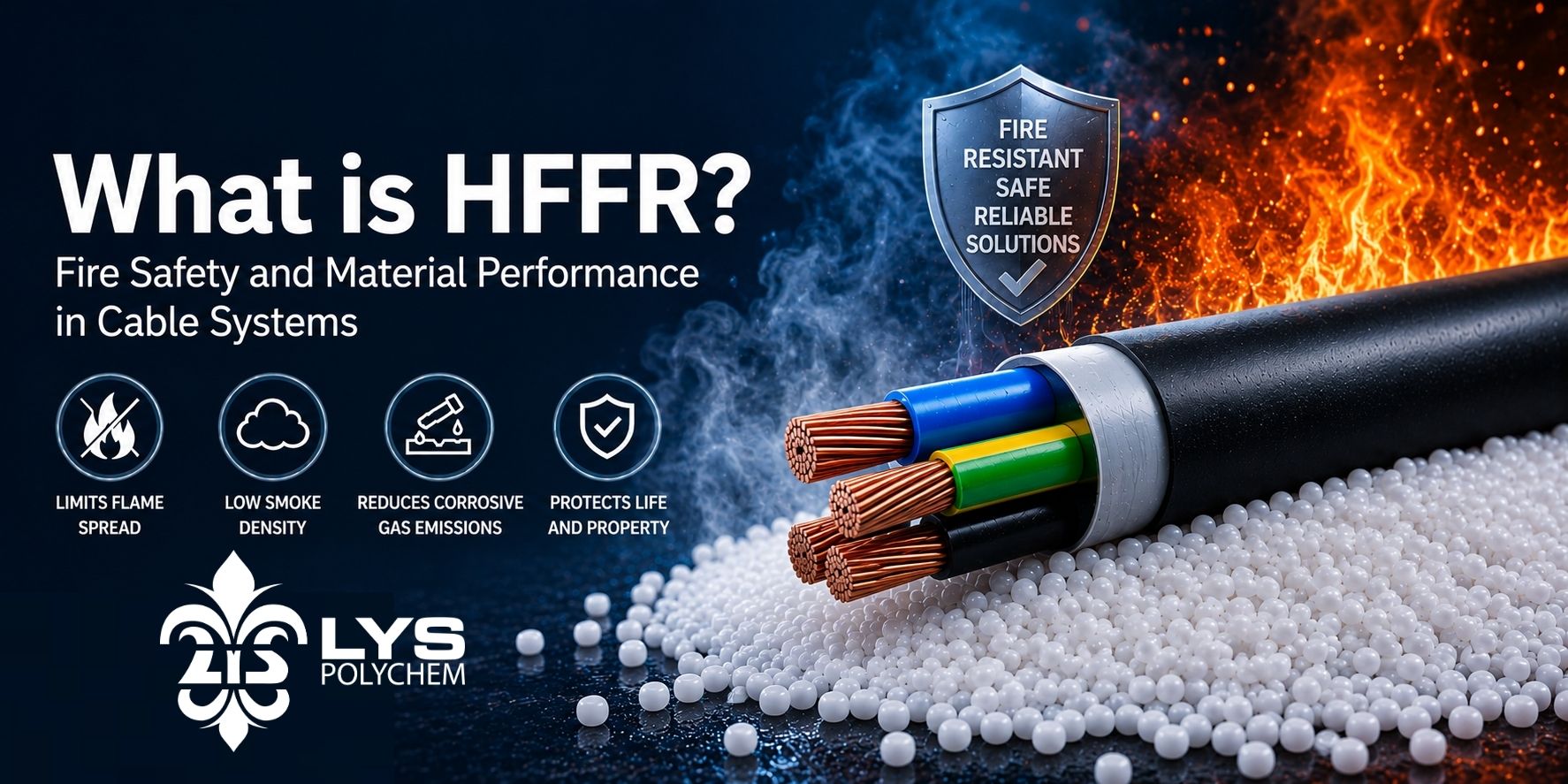
What Is HFFR? Fire Safety and Material Durability in Cable Systems
Electrical and communication cables are among the unseen yet critical components of modern infrastructure. From power transmission and data networks to industrial facilities and public transportation systems, cable performance is evaluated not only by electrical properties but also by how cables behave during a fire.
This is where HFFR cable compounds play an important role.
HFFR compounds are halogen-free, flame-retardant materials designed to help limit flame spread, reduce smoke generation, and minimise the risk of corrosive gases released during combustion.
However, the term HFFR must be understood correctly. HFFR materials do not completely prevent fire, nor are they non-combustible under all conditions. Their primary purpose is to slow down fire propagation under specified test conditions and reduce the secondary effects of fire.
What Does HFFR Mean?
HFFR stands for “Halogen-Free Flame Retardant.”
HFFR compounds are commonly used in cable insulation, filling, bedding, and outer sheath applications. These materials are designed to reduce the likelihood of cables contributing to flame propagation while limiting smoke generation and corrosive gas emissions during combustion.
For this reason, HFFR cable materials are widely preferred in buildings with high occupant density, environments where safe evacuation is critical, and facilities where sensitive electronic systems must be protected.
The Role of HFFR Materials in Fire Safety
Some conventional cable materials containing halogens may release dense smoke, toxic gases, and corrosive combustion products when exposed to fire.
These effects may not only increase the direct risks associated with fire but also reduce visibility, complicate evacuation, and cause serious damage to electronic systems and metal equipment.
HFFR cable compounds contribute to fire safety in three main areas.
Limiting Flame Spread
Flame-retardant systems used in HFFR formulations are designed to reduce the burning rate of the material and limit the spread of flames along the cable.
This property is particularly important in buildings where multiple cables are installed together in shafts, conduits, cable trays, or service channels.
Without suitable cable materials, cable routes may contribute to the spread of fire from one section of a building to another.
Limiting flame propagation can provide additional time for emergency response and help control the impact of fire within the structure.
Low Smoke Generation
Dense smoke is one of the most serious risks to human safety during a fire. Reduced visibility can make it difficult to locate emergency exits, follow evacuation signs, and move safely through a building.
HFFR cable compounds are developed to produce lower levels of smoke during combustion.
Lower smoke density can help evacuation routes remain visible for longer and support safer movement for occupants and emergency response teams.
Reduced Corrosive Gas Emissions
Materials containing halogens such as chlorine, fluorine, bromine, or iodine may generate corrosive gases when burned.
These gases can damage electronic equipment, electrical control panels, metal surfaces, communication systems, and data infrastructure.
HFFR systems are formulated without halogen-containing raw materials or with halogen levels limited according to applicable standards.
As a result, the secondary impact of fire on electronic systems and structural equipment may be reduced.
Are HFFR Cables and Fire-Resistant Cables the Same?
HFFR cables and fire-resistant cables are sometimes treated as interchangeable terms. Technically, however, they refer to different performance characteristics.
HFFR generally describes cable materials that provide the following properties:
Halogen-free formulation
Limited flame propagation
Low smoke generation
Reduced corrosive gas emissions
Fire-resistant cables, also known as circuit-integrity cables, are designed to continue transmitting electrical power or signals for a specified period during a fire.
These cables may use mica tapes, specialised insulation systems, fire barriers, and other structural solutions to maintain circuit integrity.
Therefore, an HFFR cable does not automatically maintain electrical functionality during a fire.
Depending on the project requirements, HFFR performance and circuit-integrity performance must be evaluated separately.
Key Factors That Determine HFFR Compound Performance
Developing an effective HFFR cable compound involves more than simply adding a high percentage of flame-retardant fillers to a polymer formulation.
Increasing the amount of flame-retardant additives may improve fire performance. However, it may also negatively affect processability, mechanical strength, flexibility, elongation, and surface quality.
A successful HFFR formulation must therefore achieve the right balance between fire safety, production efficiency, and long-term cable performance.
Mechanical Strength
Cable insulation and outer sheath materials must withstand tensile stress, bending, impact, abrasion, and mechanical forces that may occur during installation and operation.
The compound must retain its integrity not only under laboratory conditions but also during cable production, installation, and field use.
Processability
Stable processing on an extrusion line is essential for efficient cable manufacturing.
Flow behaviour, melt stability, surface smoothness, extrusion speed, and overall process consistency can directly affect product quality and scrap rates.
A well-balanced HFFR cable compound should support reliable extrusion without compromising the required fire, mechanical, or electrical performance.
Thermal Resistance
Cables may be exposed to different temperature conditions depending on their application.
The HFFR formulation must provide suitable performance under operating temperatures, thermal ageing, and repeated temperature changes.
Thermal stability is particularly important for cables used in industrial facilities, energy systems, transportation infrastructure, and outdoor applications.
Electrical Properties
For insulation applications, electrical properties such as dielectric strength, volume resistivity, and insulation resistance must also be considered.
A compound with strong fire performance must still meet the electrical requirements of the finished cable.
Flame and Smoke Performance
Flame propagation, smoke density, halogen acid gas emissions, and the acidity of combustion gases should be tested according to the intended application and relevant standards.
A formulation being described as “halogen-free” does not automatically mean that it provides sufficient flame-retardant or low-smoke performance.
Where Are HFFR Cable Compounds Used?
HFFR cable compounds are widely used in environments where occupant safety, evacuation conditions, and the protection of critical electronic systems are important.
Common application areas include:
Hospitals and healthcare facilities
Airports
Metro, railway, and tunnel systems
Shopping centres
Hotels
Schools and public buildings
Data centres
Power plants
Industrial facilities
Marine and shipbuilding applications
Telecommunications infrastructure
Solar energy and renewable energy systems
Each application may involve different requirements for fire classification, mechanical properties, environmental resistance, electrical performance, and processing conditions.
For this reason, HFFR compound selection should not be based solely on whether a material is halogen-free.
The cable design, installation environment, production process, required certifications, and target performance must all be considered together.
How Is HFFR Performance Tested?
The performance of HFFR materials and finished cables is evaluated through different groups of tests.
Depending on the application, testing may be carried out in accordance with IEC, EN, or other relevant national and international standards.
Common HFFR cable testing parameters include:
Flame propagation on a single cable
Flame spread in vertically mounted cable bundles
Smoke density
Halogen acid gas emissions
pH and conductivity of combustion gases
Mechanical and thermal ageing
Electrical performance
Tensile strength and elongation
Heat deformation and thermal stability
It is important to note that compound performance alone does not determine the overall performance of the finished cable.
The complete cable construction—including the conductor, insulation, filler, screening layers, bedding, and outer sheath—must be evaluated as an integrated system.
Why Is Choosing the Right HFFR Compound Important?
For cable manufacturers, selecting the right HFFR compound is not only a matter of regulatory compliance.
The material also directly affects production efficiency, extrusion stability, surface quality, scrap rates, and the field performance of the finished cable.
A well-balanced HFFR compound can help:
Support stable extrusion processes
Maintain consistent cable surface quality
Provide suitable mechanical and thermal durability
Improve flame-retardant and low-smoke performance
Reduce processing problems during production
Minimise production waste and scrap
Support compliance with target cable standards
Improve the long-term reliability of the finished product
During material development and compound selection, the cable application, manufacturing equipment, processing parameters, required test standards, and end-user expectations should be evaluated together.
LYS Polychem HFFR Cable Compound Solutions
LYS Polychem develops HFFR cable compound solutions for a wide range of cable applications by considering fire safety, manufacturing performance, and mechanical durability as an integrated system.
The selection of an HFFR compound should not focus only on flame-retardant properties.
Extrusion behaviour, surface quality, flexibility, thermal resistance, mechanical performance, and the overall performance of the finished cable must also be taken into account.
To identify the most suitable HFFR solution for a project, it is important to evaluate the intended application, cable construction, production conditions, required test standards, and expected field performance together.
Contact the LYS Polychem team to learn more about our HFFR cable compound solutions and technical product options.